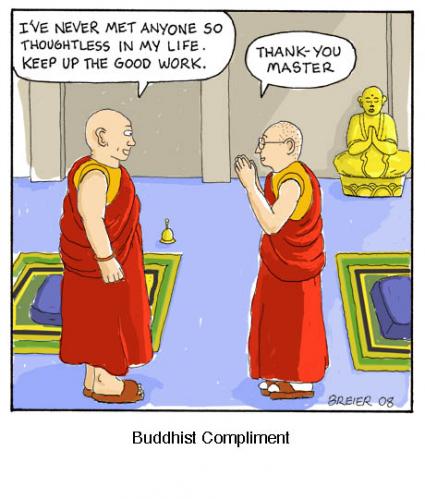
Above is a cartoon depicting an exchange between two Buddhist practitioners. The idea of the cartoon is that to reach enlightenment, one must be clear minded and not corrupted by thoughts from his surrounding, etc. In Western society, calling someone thoughtless would be considered incredibly insulting, however this cartoon shows that a Buddhist takes such a statement as a compliment. I personally feel that this is a somewhat negative stereotype. I feel this way because for the most part, Westerners consider Western traditions and ways to be the correct way of life. This cartoon goes against typical Western tradition and thought processes thus shining a negative light on the Buddhists shown in the drawing.
Brad Warner discusses the idea of enlightenment, and the general lack of understanding of the concept in Western society. I think this cartoon is a good example of this overall lack of understanding of enlightenment. The title itself, “Buddhist Compliment,” is completely condescending and somewhat disrespectful to the Buddhist way of life. We as Westerners would take offense to such a statement, but yet we can poke fun and find humor in the fact that a Buddhist would take pleasure in receiving such a compliment. On page 28, Warner tells the story of a Zen master who hears about a wandering monk who says, ”If a clear mind comes, let it come. If a cloudy mind comes, let it come.” Although this is not the entire story that Warner tells (which again can be found on page 28 of his book,) I feel that it sums up my point relatively well. We as Westerners tend to only accept what we feel is right and what we think we understand, while Buddhist are open-minded and accepting of all, whether completely thoughtless or thoughtful, enlightened or unenlightened, Buddhists respect and welcome all who are willing to give enlightenment a shot.
Brad Warner discusses the idea of enlightenment, and the general lack of understanding of the concept in Western society. I think this cartoon is a good example of this overall lack of understanding of enlightenment. The title itself, “Buddhist Compliment,” is completely condescending and somewhat disrespectful to the Buddhist way of life. We as Westerners would take offense to such a statement, but yet we can poke fun and find humor in the fact that a Buddhist would take pleasure in receiving such a compliment. On page 28, Warner tells the story of a Zen master who hears about a wandering monk who says, ”If a clear mind comes, let it come. If a cloudy mind comes, let it come.” Although this is not the entire story that Warner tells (which again can be found on page 28 of his book,) I feel that it sums up my point relatively well. We as Westerners tend to only accept what we feel is right and what we think we understand, while Buddhist are open-minded and accepting of all, whether completely thoughtless or thoughtful, enlightened or unenlightened, Buddhists respect and welcome all who are willing to give enlightenment a shot.


When I first read the comic, I wasn't quite sure how to take it. It didn't seem very "funny" to me! After reading your blog, I must say that I agree with you. Westerners do have the attitude that they have found the correct path (we're really quite ignorant for how awesome we supposedly are). I truly feel that even if one doesn't feel called to become Buddhist, one can certainly take to heart a lot of what Buddhism teaches. Thanks for your input :)
ReplyDeleteI agree that this comic shows the close-mindedness of Western culture. The word "thoughtless" here could be taken to mean forgetful or uncaring also, showing possible negative views that readers could take. This definitely fits into the idea of stereotyping, with the robes and setting. Warner made it a point to talk about the fact that not all monks wear or even like wearing the robes frequently.
ReplyDelete