For my extra credit blog, I am writing from past experience and knowledge, and not necessarily following the instructions precisely. I do however feel that this blog will be roughly what you are looking for, and mostly the same product that would have developed if I had done one of the things on the list. Of the list of possible services or classes to attend, the Tai Chi class was what interested me the most. I have long been interested in the art and practice of ancient Eastern rituals, especially the martial arts. And to me, Tai Chi is certainly that, a martial art. As a child/teenager, I took karate classes at the local academy for many years. Throughout my years of practicing karate on a regular basis, I did do quite a bit of meditation. At first it was difficult to focus my attention and power to one thing, but as time progressed and I began to understand the art/sport more, the meditation part began to make more sense. As meditation became more natural and effective, I could tell an incredible difference in my focus and power inside the studio and out. While at practice or in competition, after my meditation and mental preparation, I would enter an almost unbreakable focus and this was something that I could not do outside of the studio. This to me is still a bit puzzling, but after learning more about rituals throughout the semester it does make more sense now than in the past. It wasn't just the practice of meditation that got me to that focused state, it was also the overall ritual of mentally preparing myself, and the relaxing, comfortable environment.
Aside from my personal experience, I am an avid fan of mixed martial arts. Not a weekend passes that I don't watch at least one live event, and if there are no live events to be seen, I will watch hours upon hours of old fights. One thing I have noticed recently (since taking this course) is the difference in preparation, relaxation, in cage/ring rituals, etc of practitioners of traditional martial artists versus those of the more modern athletes of the sport. Fighters who were raised and trained in a traditional martial art tend to have a much more standard ritual and mental preparation process before a fight than those who are trained to be an MMA fighter. Their preparation and in cage calmness seems very much like the meditation I experienced personally before training or competing. It has been very interesting for me to make these small connections between traditional Eastern religions and traditional martial arts throughout the course of this semester. It does however make a lot of sense, that these meditation and relaxation practices formed from religions such as Taoism.
Friday, May 6, 2011

Sunday, April 24, 2011
Sunshine Through The Rain/Shinto
In the Sunshine Through the Rain section of Kurosawa's brilliant film, two things stood out to me in relation to the Shinto lecture. The first thing that I related back to Shinto was the idea of Kojiki, which the lecture defines as "collection of mythological stories that tell the history of Japan and its people." The connection I made between the concept of Kojiki and the film was told in the first part of Sunshine Through the Rain. In the first part, the little boy goes outside, only to be chased by a woman, who I assume is his mother and told not to go out in weather like this. The sun was shining and it was raining, the mother told him that during "sunny rains" things that he wasn't meant to see took place, such as fox weddings. The boy didn't listen and went out anyway, and he came across a fox wedding, just as his mother predicted. The mother would not let him back in because he had seen this and told him he had to go apologize, and that the foxes could be found under the rainbow. This to me is a pretty direct connection between "Dreams" and the idea of Kojiki presented in Shinto. I completely interpret the mother's tale of fox weddings, etc as a myth that tells the story of Japan's people. Secondly, I found some correlation between the film and the Shinto ethic that states: "Natural hazards (ex. thunder, creeping insects) could also create sin (impurity) & thus needed to be cleansed by religious rites." The mother being so worried about her son going out in the sunny rain to me represents her being worried about him going out in a natural hazard (the rain) and becoming sinful or impure. And her sending him to ask for forgiveness can easily be taken as cleansing religious rite. I feel that there were many connections between Shinto beliefs and practices and Kurosawa's film, and these were the two that stood out most clearly to me.
Monday, March 7, 2011
Buddhist Stereotype
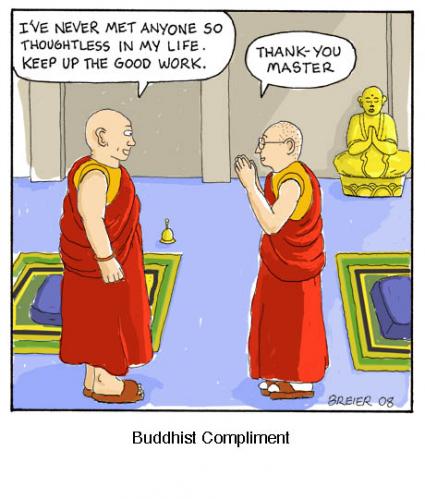
Above is a cartoon depicting an exchange between two Buddhist practitioners. The idea of the cartoon is that to reach enlightenment, one must be clear minded and not corrupted by thoughts from his surrounding, etc. In Western society, calling someone thoughtless would be considered incredibly insulting, however this cartoon shows that a Buddhist takes such a statement as a compliment. I personally feel that this is a somewhat negative stereotype. I feel this way because for the most part, Westerners consider Western traditions and ways to be the correct way of life. This cartoon goes against typical Western tradition and thought processes thus shining a negative light on the Buddhists shown in the drawing.
Brad Warner discusses the idea of enlightenment, and the general lack of understanding of the concept in Western society. I think this cartoon is a good example of this overall lack of understanding of enlightenment. The title itself, “Buddhist Compliment,” is completely condescending and somewhat disrespectful to the Buddhist way of life. We as Westerners would take offense to such a statement, but yet we can poke fun and find humor in the fact that a Buddhist would take pleasure in receiving such a compliment. On page 28, Warner tells the story of a Zen master who hears about a wandering monk who says, ”If a clear mind comes, let it come. If a cloudy mind comes, let it come.” Although this is not the entire story that Warner tells (which again can be found on page 28 of his book,) I feel that it sums up my point relatively well. We as Westerners tend to only accept what we feel is right and what we think we understand, while Buddhist are open-minded and accepting of all, whether completely thoughtless or thoughtful, enlightened or unenlightened, Buddhists respect and welcome all who are willing to give enlightenment a shot.
Brad Warner discusses the idea of enlightenment, and the general lack of understanding of the concept in Western society. I think this cartoon is a good example of this overall lack of understanding of enlightenment. The title itself, “Buddhist Compliment,” is completely condescending and somewhat disrespectful to the Buddhist way of life. We as Westerners would take offense to such a statement, but yet we can poke fun and find humor in the fact that a Buddhist would take pleasure in receiving such a compliment. On page 28, Warner tells the story of a Zen master who hears about a wandering monk who says, ”If a clear mind comes, let it come. If a cloudy mind comes, let it come.” Although this is not the entire story that Warner tells (which again can be found on page 28 of his book,) I feel that it sums up my point relatively well. We as Westerners tend to only accept what we feel is right and what we think we understand, while Buddhist are open-minded and accepting of all, whether completely thoughtless or thoughtful, enlightened or unenlightened, Buddhists respect and welcome all who are willing to give enlightenment a shot.

Sunday, February 13, 2011
Worldy Success and Liberation
I will preface this post by saying the majority of these songs contain explicit content, so listen with caution.
Worldly Success:
1.) Jadakiss, "We Gonna Make it," Rap, 2001.
2.) Young Jeezy, "I Got Money," Rap, 2006.
3.) Lil Wayne, "A Milli," Rap, 2008.
4.) Jay-Z, "Success," Rap, 2007.
5.) The Notorious B.I.G., "Juicy," Rap, 1994.
Liberation:
1.) Willie Nelson, "On The Road Again," Country, 1980.
2.) Jay-Z, "99 Problems," Rap, 2004.
3.) Jay-Z, "Dope Man," Rap, 1999.
4.) Red Hot Chili Peppers, "The Zephyr Song," Rock, 2002.
5.) Johnny Cash, "Rusty Cage," Country, 1996.
In my opinion, the more prevalent aim differs depending on whether or not you are looking at it from an American music view or the Hindu view. Obviously for Hinduism, liberation is the ultimate goal, thus making it the more prevalent aim. However, for Americans and especially from the perspective of American music (of which I focused on rap and hip-hop,) worldly success is clearly the more prevalent aim. I had no trouble at all finding (rap) songs about worldly success, it seems that almost every other song I clicked on was about money or women or success in general. Hindus strive to achieve liberation, so the prevalence of that aim for Hindus is not surprising. And we as Americans who have grown up in this materialistic society are obviously going to strive for worldly success. There was little that surprised me while doing this assignment, I had a pretty clear idea and path of what songs and artists I wanted to explore and use, so there wasn't really anything different from what I was expecting. As I stated in last week's post about community service and pleasure, I feel that there isn't much correlation, between American pop music and the Hindu aims. In America, and American music, worldly success is something that is sought after and dreamed about by basically everyone. This seeking of success is typically not to achieve anything else, it is simply a selfish hunt for oneself. While in Hinduism, one aim is used to reach the next, so with the ultimate goal being liberation, worldly success along with the other aims are simply stepping stones to reach that ultimate goal.
Worldly Success:
1.) Jadakiss, "We Gonna Make it," Rap, 2001.
2.) Young Jeezy, "I Got Money," Rap, 2006.
3.) Lil Wayne, "A Milli," Rap, 2008.
4.) Jay-Z, "Success," Rap, 2007.
5.) The Notorious B.I.G., "Juicy," Rap, 1994.
1.) Willie Nelson, "On The Road Again," Country, 1980.
2.) Jay-Z, "99 Problems," Rap, 2004.
3.) Jay-Z, "Dope Man," Rap, 1999.
4.) Red Hot Chili Peppers, "The Zephyr Song," Rock, 2002.
5.) Johnny Cash, "Rusty Cage," Country, 1996.
In my opinion, the more prevalent aim differs depending on whether or not you are looking at it from an American music view or the Hindu view. Obviously for Hinduism, liberation is the ultimate goal, thus making it the more prevalent aim. However, for Americans and especially from the perspective of American music (of which I focused on rap and hip-hop,) worldly success is clearly the more prevalent aim. I had no trouble at all finding (rap) songs about worldly success, it seems that almost every other song I clicked on was about money or women or success in general. Hindus strive to achieve liberation, so the prevalence of that aim for Hindus is not surprising. And we as Americans who have grown up in this materialistic society are obviously going to strive for worldly success. There was little that surprised me while doing this assignment, I had a pretty clear idea and path of what songs and artists I wanted to explore and use, so there wasn't really anything different from what I was expecting. As I stated in last week's post about community service and pleasure, I feel that there isn't much correlation, between American pop music and the Hindu aims. In America, and American music, worldly success is something that is sought after and dreamed about by basically everyone. This seeking of success is typically not to achieve anything else, it is simply a selfish hunt for oneself. While in Hinduism, one aim is used to reach the next, so with the ultimate goal being liberation, worldly success along with the other aims are simply stepping stones to reach that ultimate goal.
Sunday, February 6, 2011
Pleasure and Community Service
Pleasure
1.) Alabama, "Dixieland Delight," Country, 1983.
2.) Jefferson Airplane, "White Rabbit," Rock n Roll, 1967.
3.) Snoop Dogg, "Gin and Juice," Hip Hop, 1993. (Explicit)
4.) Styles P, "Good Times," Hip Hop, 2002. (Explicit)
5.) Rick James, "Mary Jane," R&B, 1978.
Community Service
1.) Future, "Spread Love Massive," Rock n Roll/Hip Hop, 2008.
2.) John Lennon, "Give Peace a Chance," Rock n Roll, 1969.
3.) Marty Robbins, "Big Iron," Country, 1959.
4.) Michael Jackson, "Earth Song," Pop, 1995.
5.) Red Hot Chili Peppers, "Power of Equality," Rock n Roll, 1991. (Explicit)
In my opinion, it is hard to say which of these aims is more prevalent. Placing pleasure before community service seems a bit selfish, but at the same time; placing the community before yourself doesn't make a ton of sense to me either. I personally would take the selfish route and say pleasure is the more prevalent aim, because ultimately making yourself happy is what's most important in life. While working on this assignment I was a bit surprised at how hard it was to find songs about community service. There were the obvious choices that seemed to be used on most everyone's list, so I had a somewhat difficult time picking out five different songs. Another observation I made was that almost any song, regardless of its true intentions, can be interpreted as a song about pleasure by one person or another. I feel that the Hindu understanding of the four aims is 100% different than what is expressed in American pop music. In my understanding of Hinduism, one aim is used to achieve the next with the ultimate goal being liberation. Songs about pleasure do have the intention to achieve worldly success, but the ultimate goal isn't liberation. I personally feel there is little to no correlation between the Hindu understanding, and American music.
1.) Alabama, "Dixieland Delight," Country, 1983.
2.) Jefferson Airplane, "White Rabbit," Rock n Roll, 1967.
3.) Snoop Dogg, "Gin and Juice," Hip Hop, 1993. (Explicit)
4.) Styles P, "Good Times," Hip Hop, 2002. (Explicit)
5.) Rick James, "Mary Jane," R&B, 1978.
Community Service
1.) Future, "Spread Love Massive," Rock n Roll/Hip Hop, 2008.
2.) John Lennon, "Give Peace a Chance," Rock n Roll, 1969.
3.) Marty Robbins, "Big Iron," Country, 1959.
4.) Michael Jackson, "Earth Song," Pop, 1995.
5.) Red Hot Chili Peppers, "Power of Equality," Rock n Roll, 1991. (Explicit)
In my opinion, it is hard to say which of these aims is more prevalent. Placing pleasure before community service seems a bit selfish, but at the same time; placing the community before yourself doesn't make a ton of sense to me either. I personally would take the selfish route and say pleasure is the more prevalent aim, because ultimately making yourself happy is what's most important in life. While working on this assignment I was a bit surprised at how hard it was to find songs about community service. There were the obvious choices that seemed to be used on most everyone's list, so I had a somewhat difficult time picking out five different songs. Another observation I made was that almost any song, regardless of its true intentions, can be interpreted as a song about pleasure by one person or another. I feel that the Hindu understanding of the four aims is 100% different than what is expressed in American pop music. In my understanding of Hinduism, one aim is used to achieve the next with the ultimate goal being liberation. Songs about pleasure do have the intention to achieve worldly success, but the ultimate goal isn't liberation. I personally feel there is little to no correlation between the Hindu understanding, and American music.
Subscribe to:
Comments (Atom)